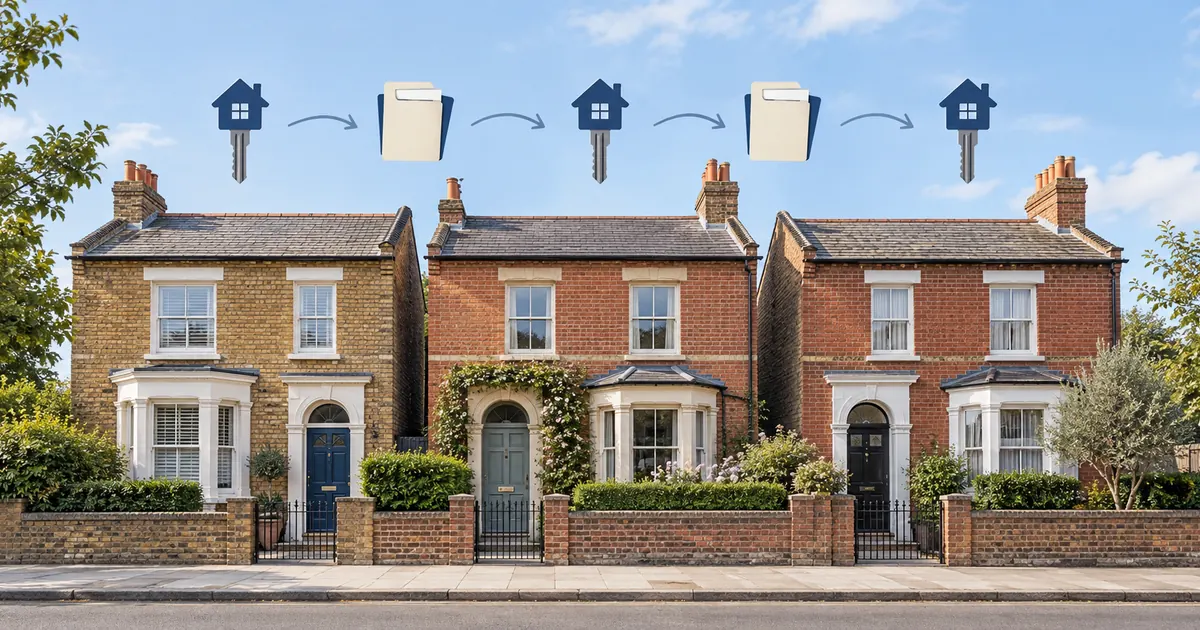

First, exchange and completion UK property stages mark two different points near the end of a purchase in England and Wales. Exchange makes the agreement legally binding, while completion transfers the money and ownership so the buyer can receive the keys. This guide explains how the stages differ, what buyers can check and why transaction-specific advice matters.
This article gives general information, not personalised legal, tax, mortgage or financial advice. Processes and documents vary by transaction. Buyers should follow advice from their own solicitor, licensed conveyancer and other regulated professionals. Scotland and Northern Ireland use different systems.
Exchange and completion UK property: the key difference
Exchange of contracts happens when the buyer and seller have signed final contract copies and their legal representatives formally exchange them. GOV.UK guidance on transferring ownership explains that the agreement becomes legally binding at this point. Usually, either party who withdraws afterwards may have to pay compensation.
Completion comes later, when the buyer’s solicitor or conveyancer transfers the purchase money. The seller moves out under the contract terms, legal transfer documents pass to the buyer’s side and the estate agent can make the keys available. GOV.UK describes the buyer as owning the property at completion.
The gap between these milestones is not a universal fixed period. The contract records the agreed completion date. A same-day exchange and completion may be possible in some transactions, while others need an interval. Exchange and completion UK property arrangements vary, so buyers should not make commitments around an assumed date before their legal professional confirms the position.
Exchange and completion UK property: what buyers check before exchange
Before authorising exchange, a buyer should understand the contract and the legal professional’s report. The agreed price, property boundaries, included fixtures and fittings, rights, restrictions, planning matters, services and completion date can all form part of the contract documentation.
The buyer should also resolve searches, enquiries and any survey issues sufficiently for their circumstances. A mortgage buyer normally needs a valid offer and must satisfy lender conditions. The buyer should make the required funds available through the method and timetable their legal professional confirms.
- Read the contract report and ask about anything unclear.
- Confirm that the legal professional has addressed title, searches and enquiries.
- Consider survey findings and any agreed follow-up work.
- Check the mortgage offer and outstanding lender conditions.
- Confirm fixtures, fittings and vacant-possession arrangements.
- Ask when buildings insurance must start.
- Verify the deposit, balance and payment instructions independently.
These checks connect with the wider conveyancing process for UK property buyers. Buyers who need more context on the property’s physical condition can also review the guide to UK property survey types.
Exchange and completion UK property: between exchange and completion
After the legal representatives exchange contracts, the parties must meet the contract terms. The buyer’s legal professional prepares the final funding and transfer steps. A mortgage lender may need notice before releasing funds, and the buyer may need to send the remaining balance in time for cleared funds to arrive.
The buyer can also prepare practical arrangements, such as removals, utilities and access. However, the legal professional should confirm when these actions are safe. Buyers should avoid treating a hoped-for date as guaranteed before exchange, and they should follow any advice about risks that could affect completion.
Property transactions involve large payments, which creates fraud risk. The official GOV.UK home-buying overview advises buyers to check that they are communicating with the intended person or business and that money goes to the correct account. Never rely on unexpected bank-detail changes in an email. Use a previously verified contact route to confirm payment instructions.
Exchange and completion UK property: what happens on completion day?

On the agreed day, the buyer’s solicitor or conveyancer transfers the purchase funds to the seller’s legal representative. Completion occurs when the contractual requirements are met and the money arrives as required. The exact communication sequence can differ, so buyers should wait for confirmation rather than assuming that an early bank transfer means keys are ready.
After confirmation, the seller or estate agent releases the keys under the agreed arrangement. The buyer can then take possession, subject to the contract. Buyers can promptly record meter readings, property condition and included items, especially where the contract identifies fixtures or fittings that should remain.
Also, a buyer considering a London purchase can place these final stages in context with Trust Point’s London guide for international buyers. Buyers can also review how to check UK property ownership information, while recognising that public register information does not replace conveyancing.
Your legal professional’s role
The legal professional coordinates the contractual and money-transfer work, but the buyer still makes informed decisions. Before exchange, the buyer decides whether the reports and replies are acceptable. The buyer also confirms the funding and completion arrangements they can meet.
After completion, the legal professional normally deals with the relevant property-tax formalities and applies to register the ownership change. The official HM Land Registry registration guidance explains when owners must register land or property in England and Wales. The precise forms, evidence and timing depend on the transaction, so buyers should request a clear post-completion update.
Tax rules and regulations change regularly. Always confirm your position with a qualified solicitor, tax adviser or financial adviser before making any decisions.
Common questions before moving
Can a buyer withdraw at this point?
Exchange normally creates a legally binding agreement in England and Wales. GOV.UK says that a party usually cannot withdraw after this point without paying compensation. The consequences depend on the contract and circumstances, so urgent legal advice is essential if a problem arises.
Is the completion date guaranteed before exchange?
Do not treat a completion date as fixed merely because the parties prefer it. The date becomes part of the contractual arrangements at exchange. Even then, buyers should follow their legal professional’s advice and avoid assuming exactly when the estate agent will release the keys.
When should a buyer transfer money?
The buyer should follow verified instructions from their solicitor or conveyancer. The required amount and deadline depend on the transaction and funding method. Buyers should independently confirm account details before transferring funds and challenge any unexpected change.
Frequently asked questions
Do exchange and completion happen on the same day?
They can, but many transactions have an interval. The appropriate arrangement depends on readiness, funding, the property chain and the parties’ agreement. Buyers should ask their legal professional what is practical for their purchase.
When does the buyer get the keys?
The estate agent normally releases the keys after the legal representatives confirm completion. The estate agent or seller usually follows instructions from the seller’s legal representative. Buyers should not arrive expecting access before that confirmation.
Does completion finish every legal task?
Completion transfers ownership and possession under the transaction, but post-completion work remains. This can include property-tax formalities and registration of the ownership change. Buyers should ask when their legal professional expects to submit and complete those tasks, and what evidence they will receive.
Exchange and completion UK property: prepare for the final stages
Exchange and completion are connected, but they do different jobs. At exchange, the agreement becomes binding. Completion transfers funds, ownership and access under the contract. Sound exchange and completion UK property preparation means reading reports, resolving questions, preparing verified funds and waiting for professional confirmation at each stage.
Furthermore, Trust Point can support the property-search and enquiry stages. Explore the current property selection and ask for factual listing information before instructing independent professionals for legal, survey, mortgage and tax decisions.