

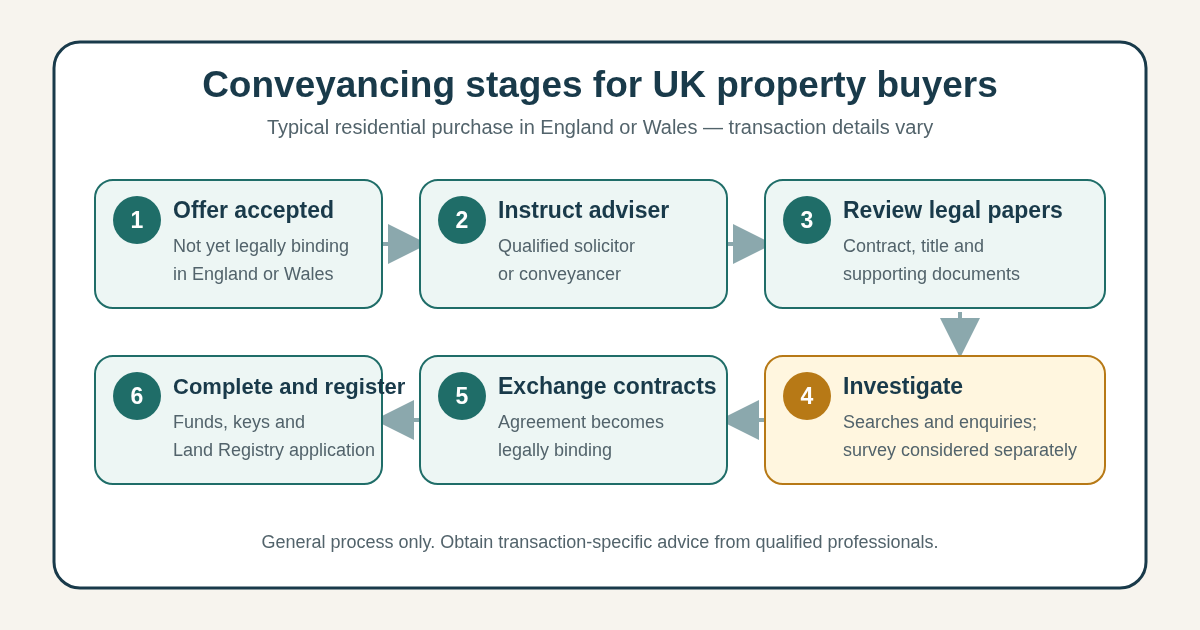
The conveyancing process for UK property buyers is the legal work that transfers a home from the seller to the buyer. For a purchase in England or Wales, it normally begins after an offer is accepted and continues through title checks, searches, enquiries, exchange of contracts, completion and registration. Knowing what happens at each stage helps buyers ask useful questions and avoid treating an accepted offer as a completed purchase.
This guide provides general information, not personalised legal, tax or financial advice. Procedures, documents, timings and costs can vary with the transaction, tenure, mortgage and buyer circumstances. Buyers should obtain advice from a qualified conveyancer or solicitor and, where relevant, a tax adviser or mortgage professional.
What does the UK conveyancing process cover?
Conveyancing is more than preparing a contract. A solicitor, licensed conveyancer or another appropriately authorised legal professional examines the title, reviews the seller’s documents, arranges searches, raises enquiries, works with a mortgage lender where relevant, and handles the transfer of funds and ownership.
The legal professional represents the buyer’s interests, but the buyer still makes important decisions. These include whether survey findings are acceptable, whether replies are clear enough and whether the proposed completion arrangements are practical. Buyers should read the legal report rather than viewing conveyancing as an administrative formality.
The conveyancing process for UK property buyers, step by step
1. Instruct a legal professional
After an offer is accepted, choose a legal professional and provide identity, funding and property details promptly. GOV.UK lists solicitors, licensed conveyancers and other authorised practitioners among the professionals who may handle the legal work. Compare more than the headline fee: ask what the quotation includes, who will manage the file, how updates are provided and whether the firm can act for the proposed mortgage lender.
HM Land Registry notes that conveyancing can be legally complex and that mortgage lenders will generally require professional representation. Buyers attempting to act without a legal representative can also face additional identity and registration requirements. Read the official HM Land Registry guidance on proceeding without legal representation before making that decision.
2. Review the draft contract and title
The seller is responsible for drawing up the legal contract, normally through the seller’s solicitor or conveyancer. The buyer’s representative reviews the contract, title information and supporting documents. The review should identify ownership, boundaries, relevant rights or restrictions and matters that need clarification.
Leasehold purchases can require additional documents and enquiries. The lease and its remaining term need particular attention, and HM Land Registry may require a certified copy of the lease for a registration application. Buyers should ask their conveyancer which leasehold documents and enquiries apply to the transaction before becoming legally committed.
3. Arrange searches and a survey
According to the official GOV.UK home-buying guidance, common searches include local authority, water and drainage, and environmental searches. Other searches may be appropriate because of the location, property or lender. Search results can reveal planning, access, infrastructure or environmental matters that are not obvious during a viewing.
A mortgage valuation is not the same as an independent survey. The lender’s valuation focuses on its security, while a survey considers the property’s condition at the chosen level of inspection. A physical defect identified by a survey may lead to a specialist report, negotiation or further legal enquiries.
4. Raise enquiries and assess the replies
The buyer’s representative asks questions arising from the title, searches, contract, survey and property information. A reply may resolve a point, reveal a risk or require further evidence. Examples include inconsistent boundaries, missing permissions, unclear rights of access or gaps in leasehold information.
Not every enquiry has a perfect answer. The important question is whether the legal and practical implications have been explained well enough for the buyer and any lender to make an informed decision. Material concerns should be addressed before exchange, not after the transaction becomes binding.
5. Satisfy mortgage, identity and source-of-funds requirements
If a mortgage is involved, most lenders will insist that a conveyancer is used. Buyers will generally need to provide identity evidence and should ask their conveyancer and mortgage professional what transaction and funding information is required. Requirements vary, so buyers should provide requested information promptly without assuming that every lender or transaction follows the same process.
6. Report, sign and exchange contracts
Before exchange, the buyer should understand the contract, be satisfied with the investigations, have suitable funding in place and confirm the completion arrangements. In England and Wales, an accepted offer is generally not legally binding until contracts are exchanged. The official GOV.UK conveyancing overview explains that exchange makes the agreement legally binding and that withdrawing afterward can lead to compensation.
The buyer should confirm the completion date, deposit arrangements, buildings-insurance requirements and any conditions that must be satisfied. Never authorise exchange merely because a preferred date is approaching; ask the legal professional whether the file is ready.
7. Prepare safely for completion
The conveyancer prepares for the transfer of funds and confirms what the buyer must provide before completion. The exact funding steps, documents and costs depend on the transaction and any lender requirements, so buyers should follow the instructions given by their conveyancer and mortgage professional.
8. Complete the purchase and register ownership
On completion, the buyer’s representative transfers the purchase money to the seller’s representative. The buyer receives the keys and becomes the owner. The conveyancer then deals with post-completion work, which may include a tax return and an application to update HM Land Registry.
HM Revenue & Customs currently states that a Stamp Duty Land Tax return, where required for an English transaction, must usually be submitted within 14 days of the effective date. Tax rules and transaction-specific exceptions can change, so buyers should confirm the current position with their adviser and the latest HMRC guidance. Wales uses Land Transaction Tax rather than SDLT.
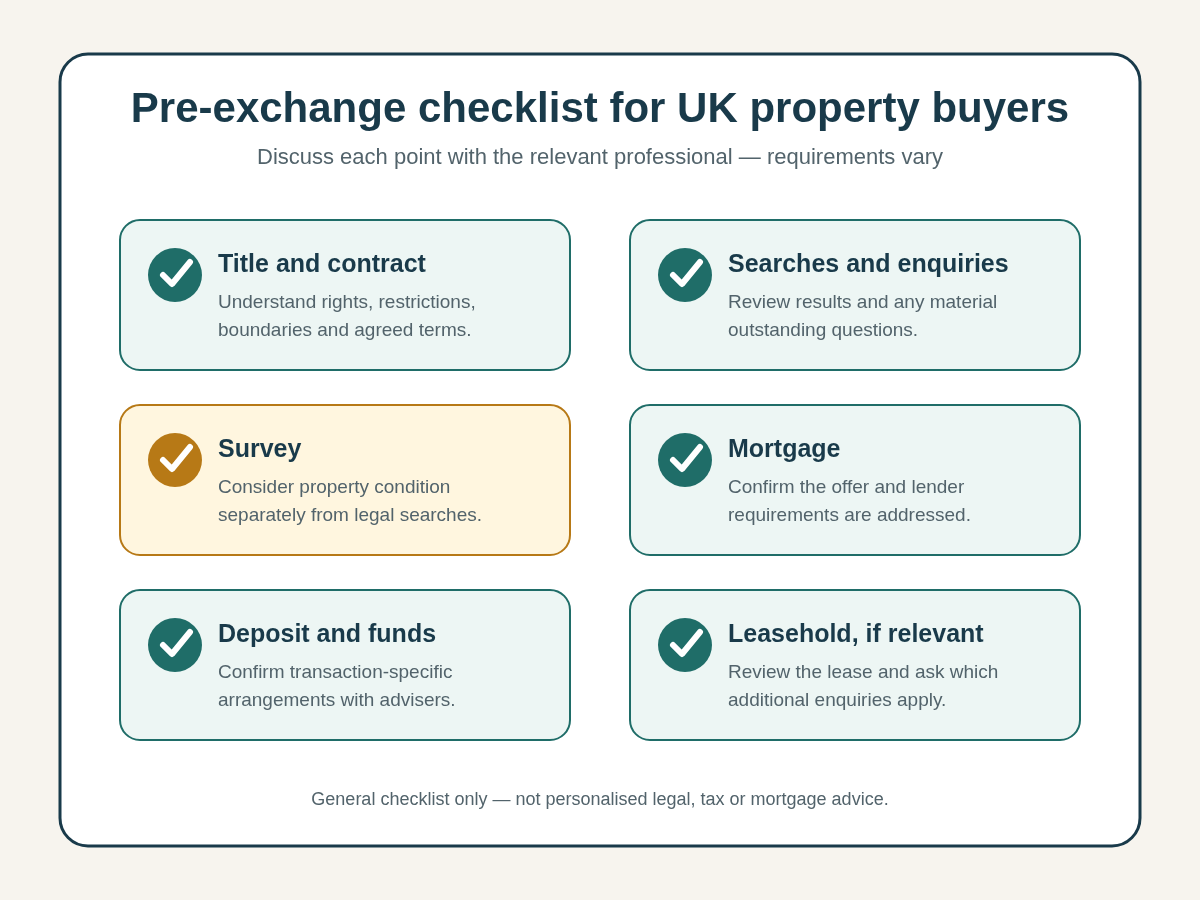
A practical pre-exchange checklist
- Have the title, boundaries, rights and restrictions been explained?
- Are the search results and replies to enquiries understood?
- Is the survey complete, including any recommended follow-up?
- Is the mortgage offer valid and are all lender conditions addressed?
- For leasehold property, are the lease and ongoing charges clear?
- Do fixtures, fittings and completion arrangements match expectations?
- Have buildings-insurance requirements been confirmed?
- Are deposit and completion funds available through verified arrangements?
What commonly delays conveyancing?
Delays can arise from incomplete information, slow replies, complex titles, leasehold management packs, mortgage conditions, property chains or unresolved survey findings. There is no dependable universal timetable. Even apparently similar purchases can move at different speeds because the legal title, funding and parties are different.
Buyers can reduce avoidable delay by instructing early, supplying documents promptly, answering questions fully and keeping their conveyancer informed about funding, travel or signing constraints. Regular, focused questions are more useful than asking for a completion date before the outstanding legal work is known.
Questions for international property buyers
International buyers should ask their conveyancer which identity and transaction documents are required and allow time to provide them. The five official sources reviewed for this article do not establish one separate conveyancing procedure for every international buyer. Where tax or mortgage questions arise, buyers should obtain advice from a qualified tax adviser or mortgage professional rather than relying on general online guidance.
Connect the legal process to the property search
Conveyancing begins after a buyer has identified a property and agreed terms, so early property research still matters. Buyers comparing new developments can read Trust Point’s guide to buying new-build property in London. A current Shoreditch property example also shows the type of listing information to review before making detailed enquiries.
When a suitable option is identified, the Trust Point contact team can help with property information and viewing enquiries. Legal advice, contract approval and the decision to exchange should remain with the buyer and their independently chosen regulated professional.
Frequently asked questions
Is an accepted offer legally binding?
In England and Wales, an accepted offer is generally not legally binding until contracts are exchanged. Scotland and Northern Ireland have different systems, so this article should not be applied to those jurisdictions.
Is a survey part of conveyancing?
A survey and conveyancing are separate but connected. The survey considers physical condition, while conveyancing examines legal title and transaction matters. Survey findings can lead to further enquiries, specialist investigation or negotiation.
Can a buyer do their own conveyancing?
HM Land Registry explains that a person may make an application without legal representation, but the law and registration process can be complex. Mortgage lenders generally require a conveyancer, and unusual titles or leasehold purchases can add further issues. Obtain professional advice before deciding.
What happens after completion?
The buyer’s representative normally handles the relevant property-tax formalities and applies to register the new ownership. HM Land Registry explains that registration provides formal evidence of ownership; its registration guidance outlines the supporting documents that may be required.
Conclusion
The conveyancing process for UK property buyers protects the legal transfer and gives the buyer a structured opportunity to understand the property before becoming bound. Choose an appropriately regulated professional, provide documents early and resolve material questions before exchange. Trust Point can support the property-search and enquiry stage, while qualified advisers should handle legal, tax and financial decisions.


[…] the wider legal process, read Trust Point’s guide to the conveyancing process for UK buyers. This article provides general information, not legal advice. Land records and procedures can […]
[…] Flood information can affect your questions, survey instructions, conveyancing work and insurance enquiries. It should form one part of wider due diligence, alongside the practical steps in Trust Point’s UK conveyancing guide. […]